Topical treatment
Solutions that supply nutrients, vasodilators, energising substances and, if an infection is suspected, antimicrobials.
Dermatological assessment of hair loss and treatment tailored to the cause: topical solutions, systemic treatments or PRP.
Hair loss has various causes, and treatment is tailored to the suspected cause. The hair growth cycle has four phases: anagen (active growth), catagen (transition), telogen (rest) and exogen (release of the sheath). Alopecia can be non-scarring, when the cause is not related to fibrosis of the bulb or of the surrounding tissue, or scarring, when it results from an intense inflammatory process at the hair root.
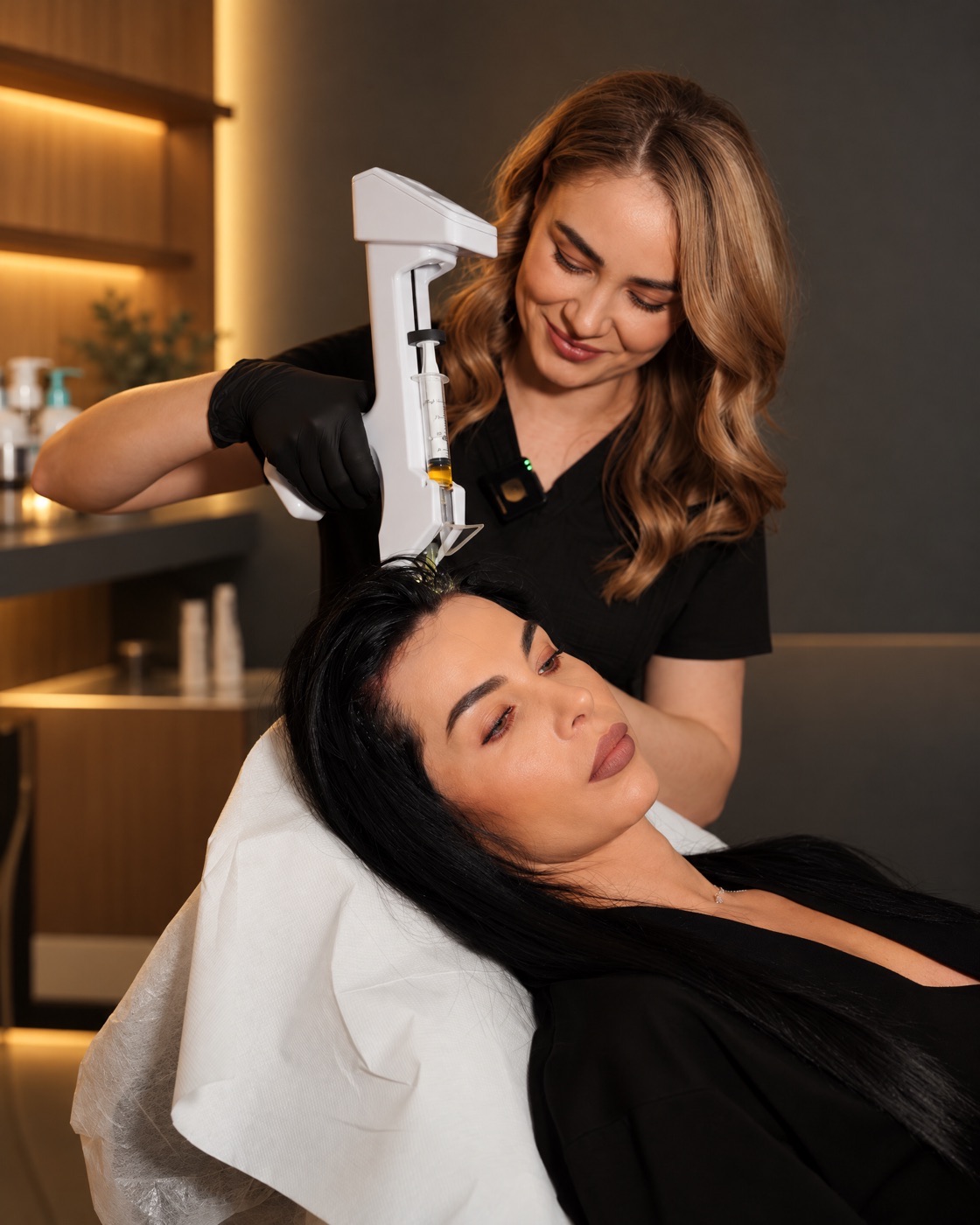
The dermatological consultation establishes the suspected type of alopecia, and in certain situations a skin biopsy is needed, the only investigation that can establish a definitive diagnosis. Treatment is based on topical solutions, systemic treatments and PRP, a treatment carried out with the patient’s plasma, which is rich in growth factors.
Solutions that supply nutrients, vasodilators, energising substances and, if an infection is suspected, antimicrobials.
Treatment given systemically, chosen according to the cause of the hair loss.
Blood is drawn and centrifuged to separate the red cells from the plasma. The plasma, rich in growth factors, is used in the treatment.
The dermatologist assesses the hair loss and establishes the suspected type of alopecia.
In certain situations a skin biopsy is performed, for a definitive diagnosis.
Treatment is personalised according to the type of alopecia: topical, systemic or PRP.
Causes include alopecia areata, often associated with autoimmune conditions, frequently of the thyroid; tinea capitis, a fungal infection; and telogen effluvium, which appears a few weeks after stress, an illness or COVID-19. Other causes are androgenetic alopecia; traction alopecia, caused by very tight hairstyles; and trichotillomania, in which hairs are pulled out and hairless patches appear.
Genetic predisposition and family history are important. In women, hair loss is diffuse, especially at the vertex; in men, it occurs mainly in the temporal and frontal areas and at the vertex, without affecting the occipital area.
It usually occurs in conditions such as lupus, after burns, in lichen planopilaris or in folliculitis decalvans.
Appointments are made by phone only, Monday to Friday, between 10:00 and 18:00.