Facelift
Surgical procedure that corrects laxity of the skin and of the deep tissues of the face and neck.
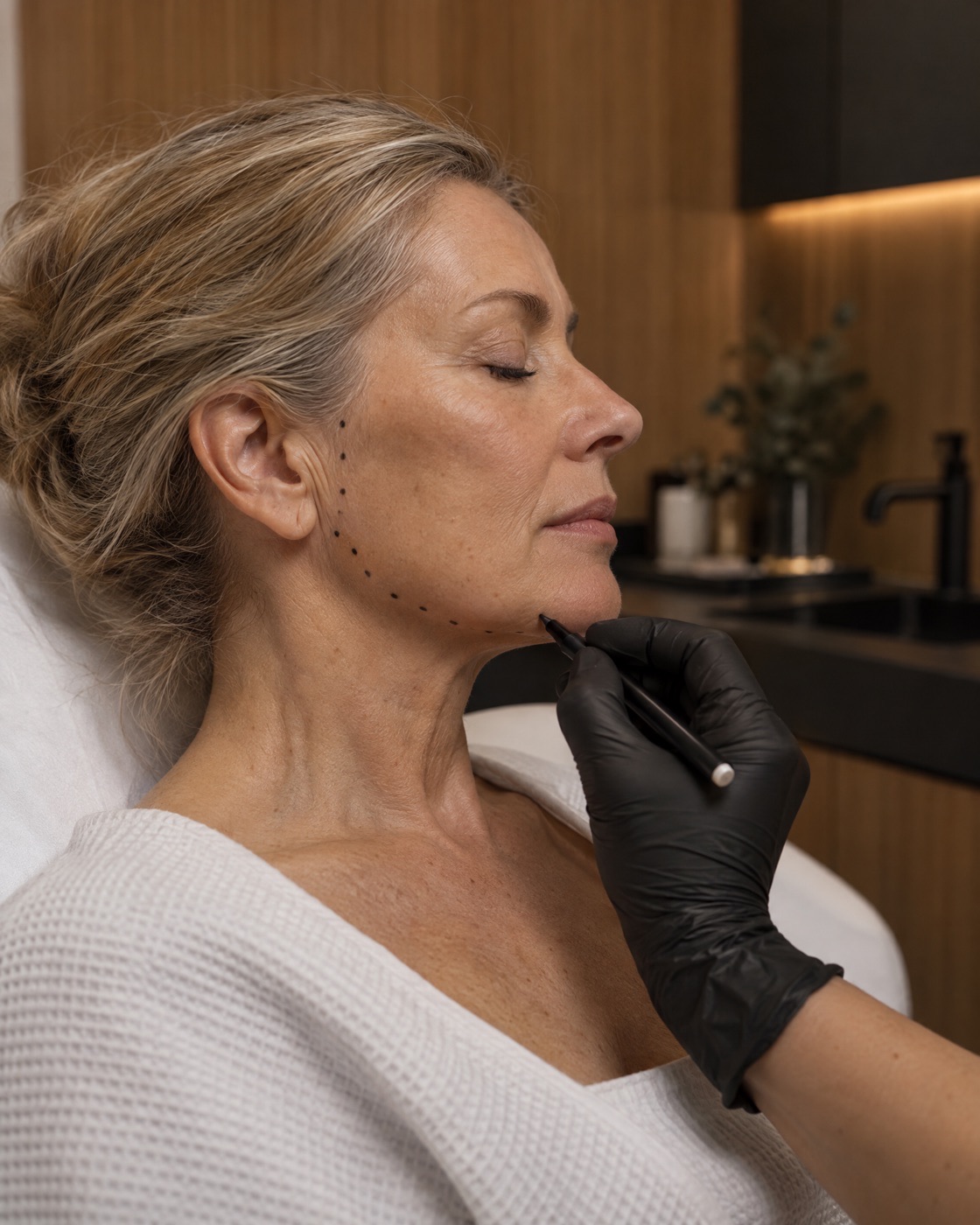
What it is
A facelift (rhytidectomy) is the surgical procedure that corrects laxity of the skin and of the deep tissues of the face and neck. It addresses sagging skin on the face and under the chin, the lines around the mouth (marionette lines) and a double chin.
The procedure is performed under general or local anaesthesia and takes 2–3 hours. The incisions are placed around the ear. Methods vary, but the procedure consists of separating the skin from the underlying tissues (muscle and fat) and tightening it; depending on the case, fat is also removed from the face or neck. The SMAS (Superficial Musculo-Aponeurotic System) technique also addresses the deep musculo-aponeurotic layer of the face, not just the skin.
The procedures carried out in the operating theatre are agreed jointly, at the consultation.
- sagging skin on the face
- marionette lines (around the mouth)
- sagging skin under the chin
- double chin
How it works
- 01
Consultation
The desired results are discussed and the procedures to be carried out are agreed jointly.
- 02
Preparation
Aspirin and other anti-inflammatory medicines are avoided, hydration must be very good and, where applicable, hair colouring is done before surgery.
- 03
The procedure
Under general or local anaesthesia, over 2–3 hours: through incisions around the ear, the skin is separated from the underlying tissues and tightened; where appropriate, fat is also removed from the face or neck.
- 04
First week
The area is swollen and the face feels very tight. Dressings are changed as recommended by the doctor, and analgesics are prescribed for discomfort.
- 05
Healing
Healing is complete within 2–6 weeks, depending on the complexity of the procedure; rest and avoiding physically strenuous activities are recommended during this period.
Good to know
- Swelling and bruising are at their peak in the first 2 weeks and subside gradually.
- Physically strenuous activities are avoided during the healing period.
- A facelift does not stop the natural ageing process; the result can be maintained through complementary aesthetic treatments and a healthy lifestyle.
- The duration of the result depends on the complexity of the procedure and on the patient's lifestyle.
- The results of aesthetic procedures vary from one person to another.
Frequently asked questions
What is a facelift?
Rhytidectomy is a surgical procedure that corrects laxity of the skin and of the deep tissues of the face and neck.
How long does recovery take?
The bandage is kept on for 1–2 days. Swelling and bruising are at their peak in the first 2 weeks and subside gradually, and social activities can be resumed after 3–4 weeks.
At what age can a facelift be performed?
As a rule after the age of 45–50, when sagging of the tissues (ptosis) is evident. For younger patients with moderate laxity, there are mini-lift techniques.
Is a facelift permanent?
The results are long-lasting, but a facelift does not stop the natural ageing process. The results can be maintained through complementary aesthetic treatments and a healthy lifestyle.
What is the SMAS technique?
The SMAS (Superficial Musculo-Aponeurotic System) technique addresses the deep musculo-aponeurotic layer of the face, not just the skin.
Appointments are made by phone only, Monday to Friday, between 10:00 and 18:00.